
What Is a Blockchain? – Introduction, Best And More
What Is a Blockchain? – If you’ve been anywhere near discussions on technology, finance or even digital art for the last 10 years then chances are you have heard of blockchain. It might sound overly complicated and even frightening, but in its essence blockchain is a very simple, yet sophisticated, concept.
It’s like a shared digital notebook that is spread out over thousands of computers in which each transaction is permanent, public, and can’t easily be falsified; no single person is in control of it, but we can all rely on it.
In this guide, I will break down blockchain into terms that will actually make sense – without the confusing terms or pointless jargon – and explain to you, what blockchain is, how it works and why it is considered such a huge deal.
What Is A Blockchain? (In simple terms)
A blockchain is a digital, decentralized ledger that records information in an un-tamperable, secure and transparent way across computers.
Let’s simplify that:
- Ledger = A record book of transactions
- Decentralized = Not controlled by one authority
- Secure = Protected using advanced cryptography
- Transparent = Everyone on the network can verify it
So, instead of trusting a bank, company, or government to maintain records, blockchain allows a network of users to collectively maintain and verify them.
Why Was Blockchain Created?
Before blockchain, digital transactions had one major problem: trust.
Whenever you sent money online or shared data, you had to rely on a middleman—like a bank, payment gateway, or platform—to verify and process it.
This created issues like:
- High fees
- Delays
- Risk of fraud
- Centralized control
Blockchain was designed to solve these problems by removing the need for intermediaries and replacing trust with technology and consensus.
How Does Blockchain Work?
Let’s walk through the process step-by-step in a simple way.
- A Transaction Is Requested
Someone initiates a transaction. For example:
- Sending money
- Signing a digital contract
- Recording data
- The Transaction Is Broadcast
The request is sent to a network of computers (called nodes).
- Validation Happens
These nodes verify the transaction using algorithms and rules.
- A Block Is Created
Once verified, the transaction is grouped with others into a block.
- The Block Is Added to the Chain
This block is linked to the previous one, forming a chain—hence the name blockchain.
- The Transaction Is Complete
The record becomes permanent and cannot be altered.
Key Components of Blockchain
Understanding blockchain becomes easier when you break it into its core elements.
- Blocks
Each block contains:
- Transaction data
- Timestamp
- A unique identifier (hash)
- Chain
Blocks are linked together in sequence. Each block references the previous one, creating a secure chain.
- Nodes
These are computers in the network that:
- Store copies of the blockchain
- Validate transactions
- Consensus Mechanism
This ensures everyone agrees on what is valid.
Table: Core Blockchain Components
| Component | Description |
| Block | A collection of transaction data |
| Chain | A sequence of connected blocks |
| Node | A computer participating in the network |
| Hash | A unique digital fingerprint of data |
| Consensus Mechanism | A method used to validate transactions |
What Makes Blockchain Unique?
Blockchain isn’t just another database. It has some powerful characteristics that make it stand out.
- Decentralization
No central authority controls the system. Instead, control is distributed across many nodes.
- Transparency
Every transaction is visible to participants in the network.
- Immutability
Once data is recorded, it cannot be changed.
- Security
Advanced cryptography protects the data.
Table: Blockchain vs Traditional Systems
| Feature | Blockchain | Traditional System |
| Control | Decentralized | Centralized |
| Transparency | High | Limited |
| Security | Cryptographic | Depends on institution |
| Data Changes | Immutable | Editable |
| Speed | Moderate | Often faster |
Types of Blockchain
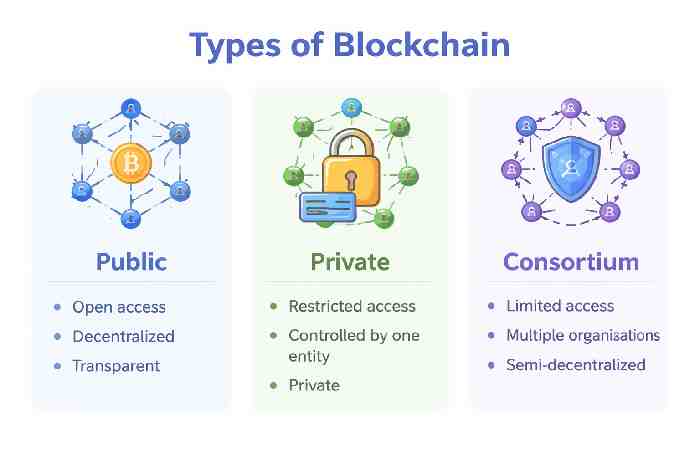
Not all blockchains are the same. They come in different forms depending on their use case.
- Public Blockchain
- Open to anyone
- Fully decentralized
- Transparent
Example use: cryptocurrencies
- Private Blockchain
- Controlled by a single organization
- Restricted access
Example use: internal company systems
- Consortium Blockchain
- Managed by a group of organizations
- Semi-decentralized
banking networks
Table: Types of Blockchain
| Type | Access Level | Control | Use Case |
| Public | Open | Decentralized | Cryptocurrencies |
| Private | Restricted | Single organization | Enterprise solutions |
| Consortium | Limited | Multiple organizations | Industry collaborations |
What is a Hash?
A hash is like a digital fingerprint.
- It’s created using a mathematical function
- Each block has its own unique hash
- Even a tiny change in data creates a completely different hash
This is what makes blockchain so secure.
What Is Mining?
Mining is the process of validating transactions and adding them to the blockchain.
Miners:
- Solve complex mathematical problems
- Verify transactions
- Earn rewards for their work
This process ensures the network remains secure and trustworthy.
What Is a Consensus Mechanism?
A consensus mechanism is how blockchain networks agree on what is true.
Common Types:
- Proof of Work (PoW)
Requires computational power - Proof of Stake (PoS)
Based on ownership of tokens
Table: Consensus Mechanisms
| Mechanism | How It Works | Energy Use |
| Proof of Work | Solves complex puzzles | High |
| Proof of Stake | Validators stake coins | Low |
Real-World Applications of Blockchain
Blockchain isn’t just about cryptocurrency. It’s being used in many industries.
- Finance
- Faster payments
- Lower fees
- Cross-border transactions
- Supply Chain
- Track goods in real time
- Ensure authenticity
- Healthcare
- Secure patient records
- Improve data sharing
- Voting Systems
- Transparent elections
- Reduced fraud
- Real Estate
- Smart contracts
- Faster property transfers
Table: Blockchain Use Cases
| Industry | Application |
| Finance | Digital payments, remittances |
| Healthcare | Patient data management |
| Supply Chain | Product tracking |
| Government | Voting systems |
| Real Estate | Property transactions |
Advantages of Blockchain
Let’s talk about why blockchain is gaining so much attention.
- Trust Without Intermediaries
You don’t need a middleman to verify transactions.
- High Security
Data is encrypted and distributed across the network.
- Transparency
All participants can see the transaction history.
- Efficiency
Processes can be automated using smart contracts.
Disadvantages of Blockchain
It’s not perfect. There are still some challenges.
- Scalability Issues
Handling large volumes of transactions can be slow.
- Energy Consumption
Some systems (like Proof of Work) use a lot of energy.
- Complexity
Not easy for beginners to understand or implement.
- Regulation Uncertainty
Laws and policies are still evolving.
What Are Smart Contracts?
Smart contracts are self-executing agreements written in code.
- Automatically execute when conditions are met
- No need for intermediaries
- Reduce errors and delays
Example:
If payment is received → ownership is transferred automatically.
Blockchain and Cryptocurrency

Blockchain is the technology behind cryptocurrencies.
- It records all transactions
- Ensures security and transparency
- Eliminates the need for banks
But remember:
Blockchain ≠ Cryptocurrency
Cryptocurrency is just one use case of blockchain.
The Future of Blockchain

Blockchain is still evolving, but its future looks promising.
We’re already seeing trends like:
- Integration with AI
- Growth of decentralized finance (DeFi)
- Expansion into new industries
In the coming years, blockchain could reshape how we:
- Store data
- Conduct business
- Build trust online
Common Myths About Blockchain
Let’s clear up some confusion.
Myth 1: Blockchain Is Only for Crypto
Reality: It has many applications beyond digital currency.
Myth 2: It’s Completely Anonymous
Reality: Transactions are traceable, though identities may be hidden.
Myth 3: It Can’t Be Hacked
Reality: While highly secure, vulnerabilities can exist in implementation.
Simple Analogy to Understand Blockchain
Imagine a shared Google Sheet:
- Everyone can see it
- Everyone can verify entries
- No one can delete past data
- Every change is recorded
That’s essentially how blockchain works—but with much stronger security.
Final Thoughts
Blockchain isn’t just a word that we hear tossed around constantly anymore, it is a very real and highly useful technology that is transforming the way we approach trust, information and digital transactions. Ultimately, the basis of blockchain is built around transparency, security and decentralisation- taking power away from intermediaries and giving it back to users.
It is clear that there are some problems still needing solutions, but the future for blockchain is undeniable and it is slowly becoming a core building block to our digital existence, from finance and health, to supply chains and even more. And in all honesty, once you get to understand the basics of how it works, it’s not anywhere near as difficult to get your head around as you initially might expect.