
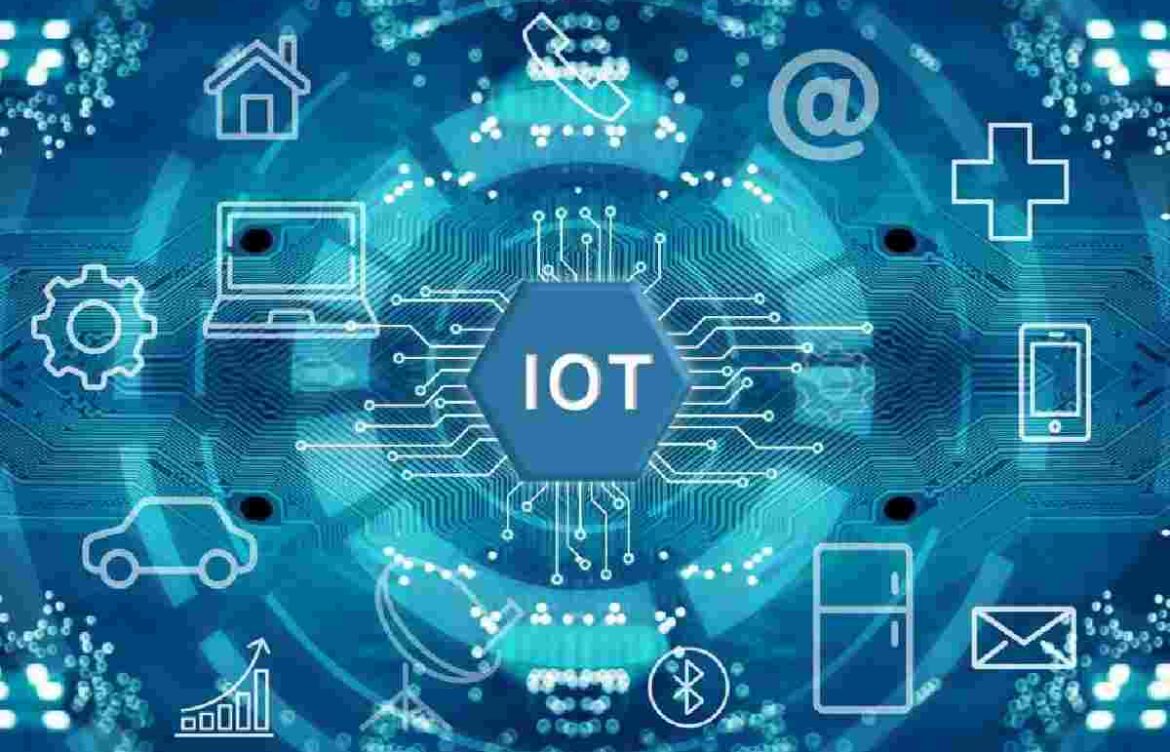
What is the Internet of Things (IoT)?
Internet of Things (IoT) refers to an enormous network of physical objects that people encounter daily, i.e., appliances, cars, watches, and even machines at the factory connected to the internet. These intelligent objects can sense, have software and internet connections hence they can gather information and transmit it to other objects or individuals.
Consider it in the following way: Your intelligent refrigerator can know your mobile phone that you are out of milk. A smart watch intervenes your steps and heart rate. An intelligent traffic light will be modified depending on the number of vehicles present in the queue.
Internet of Things – IoT
Internet of Things (IoT) is a massive network of physical devices that are interconnected, have sensors, software and other connection capabilities, which allow them to gather and share data on the internet. Such things may include domestic devices and wearables to track your fitness, as well as, the machines and smart infrastructure of cities.
Simply put, IoT relates to the ability of day-to-day things to be connected to the internet to enable them transmit and obtain information without the human touch. The industries that are undergoing change with this technology include healthcare, manufacturing, transportation, agriculture, and retail.
International Data Corporation reveals that there has been a rapid increase in the number of connected IoT devices in the world in recent decade to the point of billions of active devices in the world.
Key Features of Internet of Things (IoT)
The Internet of Things (IoT) is designed to connect devices, collect data, and automate processes. Below are the most important features that make IoT powerful and widely used across industries.
1. Connectivity
Connectivity is the foundation of IoT. Devices are connected through networks such as:
- Wi-Fi
- Bluetooth
- Cellular (4G/5G)
- Satellite
- Low-power networks like Zigbee
This allows devices to communicate with each other and with cloud platforms such as Amazon Web Services.
2. Sensors and Data Collection
IoT devices use sensors to collect real-time data from the environment. Examples include:
- Temperature and humidity
- Motion and location
- Heart rate and health data
- Energy consumption
This data helps businesses and individuals make informed decisions.
3. Real-Time Monitoring
IoT enables continuous monitoring of systems and processes. For example:
- Tracking patient health
- Monitoring industrial machines
- Managing smart city traffic
Companies like Cisco develop solutions for real-time monitoring.
4. Automation and Control
IoT systems can automatically perform actions based on collected data. Examples:
- Smart lighting turning on when motion is detected
- Automated irrigation systems
- Manufacturing process automation
Automation improves efficiency and reduces human effort.
5. Remote Access
Users can access and control devices from anywhere using:
- Mobile apps
- Web dashboards
- Cloud platforms
Smart home ecosystems from Google allow remote control of appliances.
6. Data Analytics and Intelligence
IoT platforms analyze collected data to:
- Identify patterns
- Predict failures
- Optimize performance
- Support decision-making
Artificial intelligence integration makes IoT systems smarter.
7. Scalability
IoT systems can scale from a few devices to millions. This flexibility supports:
- Smart cities
- Large industrial operations
- Global logistics networks
8. Security
Security is essential due to the large number of connected devices. It includes:
- Encryption
- Authentication
- Secure data transmission
Organizations like IBM focus on IoT cybersecurity solutions.
9. Interoperability
IoT devices from different manufacturers can work together using common standards and protocols.
10. Energy Efficiency
Many IoT devices are designed to consume low power, making them suitable for long-term and remote operations.
Key Characteristics of IoT
| Feature | Description |
| Connectivity | Devices connect via Wi-Fi, Bluetooth, cellular, or LPWAN |
| Sensors | Collect data such as temperature, motion, humidity |
| Data Processing | Cloud or edge systems analyze collected data |
| Automation | Devices perform actions automatically |
| Scalability | Can support millions of connected devices |
How Does IoT Work? (Simple Breakdown)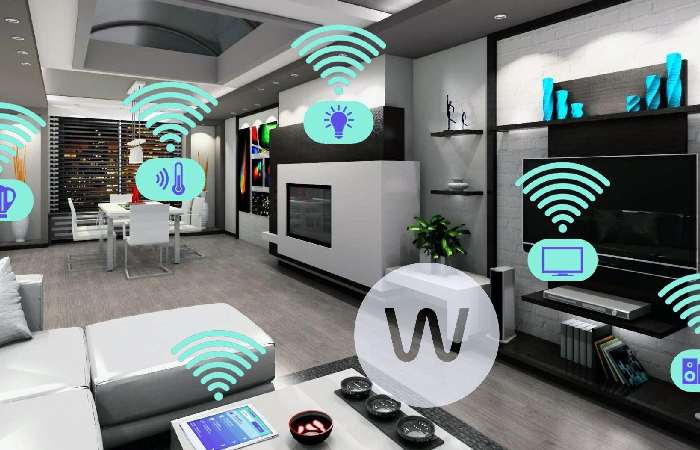
IoT needs a few key parts to work:
| Part | What It Does | Example |
| 1. Sensors | Detect real-world things (temperature, motion, light, etc.) and turn them into data | A sensor in a farm checks soil moisture |
| 2. Connectivity | Sends data over the internet (Wi-Fi, Bluetooth, 4G/5G) | Your smart speaker connects to Wi-Fi |
| 3. IoT Platform | A “control center” (usually in the cloud) that collects, stores, and analyzes data | Amazon or Google’s cloud systems |
| 4. Unique ID | Every device has its own “name” so the network knows who’s who | Like an IP address for your laptop |
| 5. AI & Machine Learning | Helps devices learn, predict, and act smarter over time | Netflix suggests shows you like |
Example in action: A smart thermostat senses the room is too hot → sends data to the cloud → AI sees you’re usually home at 5 PM → turns on AC before you arrive.
The 4 Main Types of IoT
| Type | What It’s For | Real-Life Examples |
| 1. Consumer IoT | Makes daily life easier and fun | Smart TVs, fitness trackers, voice assistants (Alexa, Google Home), smart lights |
| 2. Commercial IoT | Helps businesses run better | Smart shelves in stores that know when items are low, hotel key cards, digital menus |
| 3. Industrial IoT (IIoT) | Used in factories and big machines | Robots that predict when they need repair, sensors on conveyor belts, oil rig monitors |
| 4. Infrastructure IoT | Makes cities smarter and safer | Smart streetlights that dim when no one’s around, traffic cameras, flood sensors |
Cool Real-World Uses of IoT
- Farming: Sensors check soil, weather, and crops → farmers know exactly when to water or harvest.
- Healthcare: Wearable devices monitor heart rate and alert doctors if something’s wrong.
- Transportation: Self-driving cars “talk” to traffic lights to avoid jams.
- Factories: Machines tell managers when they’re about to break—saving time and money.
Why IoT Matters
- Saves time and energy
- Reduces waste
- Makes life safer and more convenient
- Helps businesses make smarter decisions
The Future of IoT
Experts say billions more devices will connect in the next few years. With AI, IoT will get even smarter—imagine:
- Fridges that order groceries automatically
- Cities with zero traffic jams
- Factories that run themselves
Applications of Internet of Things (IoT)
The Internet of Things (IoT) is transforming many industries by connecting devices, collecting real-time data, and enabling smart automation. Below are the major applications of IoT in different sectors.
1. Smart Homes
IoT is widely used in home automation to improve comfort, convenience, and security. Examples include:
- Smart lighting and thermostats
- Voice-controlled assistants
- Smart security cameras and door locks
- Automated appliances
Companies like Amazon and Google provide smart home ecosystems.
2. Healthcare
IoT improves patient care and monitoring through connected medical devices. Applications include:
- Remote patient monitoring
- Wearable fitness trackers
- Smart medical equipment
- Emergency alert systems
Devices from Fitbit and healthcare solutions by Philips are widely used.
3. Transportation and Logistics
IoT enhances transportation efficiency and safety. Examples:
- Vehicle tracking
- Fleet management
- Smart traffic systems
- Autonomous vehicles
Connected vehicle technologies from Tesla use IoT for real-time data.
4. Smart Agriculture
Farmers use IoT for precision farming. Applications include:
- Soil moisture monitoring
- Automated irrigation
- Weather tracking
- Livestock monitoring
This improves crop yield and resource management.
5. Industrial IoT (IIoT)
Industries use IoT for automation and predictive maintenance. Examples:
- Machine performance monitoring
- Quality control
- Supply chain optimization
- Energy management
Companies such as Siemens and General Electric lead industrial IoT innovation.
6. Smart Cities
IoT helps manage urban infrastructure. Applications include:
- Smart traffic and parking
- Waste management
- Energy-efficient lighting
- Water management
Governments use IoT to improve sustainability and urban living.
7. Retail
Retailers use IoT to enhance customer experience and operations. Examples:
- Smart shelves and inventory tracking
- Personalized promotions
- Contactless payments
- Supply chain monitoring
Retail giants like Walmart use IoT for efficient inventory management.
8. Energy and Utilities
IoT is used to manage energy consumption and distribution:
- Smart grids
- Smart meters
- Renewable energy monitoring
- Power usage optimization
This supports sustainability and cost savings.
9. Education
IoT enables smart learning environments:
- Connected classrooms
- Virtual labs
- Attendance tracking
- Interactive learning tools
Universities and platforms like MIT explore IoT in education.
10. Security and Surveillance
IoT systems are used for:
- Smart surveillance cameras
- Intrusion detection
- Biometric access control
- Disaster monitoring
Benefits of IoT
| Benefit | Explanation |
| Efficiency | Automation reduces manual tasks |
| Cost Savings | Optimized operations reduce waste |
| Data Insights | Real-time analytics improves decisions |
| Improved Safety | Early detection of risks |
| Enhanced Customer Experience | Personalized services |
Challenges of IoT
| Challenge | Description |
| Security Risks | Cyberattacks and hacking |
| Privacy Concerns | Data misuse |
| Interoperability | Device compatibility issues |
| High Initial Cost | Infrastructure investment |
| Data Management | Handling large data volumes |
Security is one of the major concerns in IoT deployment.
Real-World Examples of IoT
| Company | IoT Application |
| Amazon | Smart home devices |
| Tesla | Connected electric vehicles |
| Philips | Smart healthcare systems |
| John Deere | Smart agriculture machinery |
These companies leverage IoT to improve efficiency and innovation.
Best Companies of IoT
India
| Company | Type / Industry | IoT Focus | Notes |
| Tata Communications | Telecom / IoT Platform | Global IoT connectivity, device management | Large-scale IoT networks for multiple industries (Inventiva) |
| Infosys | IT / Digital Services | IoT data analytics, Edge insights | IoT as part of digital transformation solutions (Inventiva) |
| Wipro | IT / Consulting | IoTNXT platform, analytics, enterprise IoT | End-to-end IoT integration (Inventiva) |
| HCL Technologies | IT / Digital | IoTWorks platform, AI-enabled IoT | Industrial IoT and predictive analytics (Inventiva) |
| Tech Mahindra | IT / Consulting | Connected devices, AIoT | Smart city, automotive, enterprise solutions (Inventiva) |
| MapmyIndia | Mapping / Telematics | IoT-based navigation, connected location services | Telematics and IoT-based SaaS (Wikipedia) |
| Tech4LYF Corporation | Industrial IoT / Embedded | IIoT platforms, monitoring dashboards | Industrial automation and IoT integrations (Wikipedia) |
| Dot Com Infoway | Software / IoT Dev | Custom IoT solutions | IoT and web/mobile development (IoT Avenue) |
| Rushkar Information Technology | IoT / Tech | IoT app and device solutions | Custom IoT builds (IoT Avenue) |
| Zerozilla Technologies | IoT / Software | IoT and cloud platforms | Software + connected devices (IoT Avenue) |
| Altiux Innovation | IoT Solutions | Smart sensors and devices | Location-based IoT products (IoT Avenue) |
| BrillMindz | IoT / Mobile Tech | IoT app integration | Connected mobile + device ecosystems (IoT Avenue) |
| Contus | IoT / SaaS | IoT platform apps and services | Custom IoT deployments (IoT Avenue) |
Europe
| Company | Country | Key IoT Focus | Industries Served |
| Siemens | Germany | Industrial IoT, automation, digital twins | Manufacturing, energy, infrastructure |
| Bosch | Germany | Smart home, mobility, Industry 4.0 | Automotive, smart cities, consumer electronics |
| Ericsson | Sweden | IoT connectivity, 5G networks | Telecom, logistics, transportation |
| Nokia | Finland | Industrial IoT, private wireless networks | Smart factories, mining, ports |
| Schneider Electric | France | Smart energy and automation | Buildings, energy, data centers |
| SAP | Germany | IoT platforms and cloud solutions | Enterprise, supply chain, retail |
| Vodafone | UK | IoT connectivity and device management | Smart cities, automotive, healthcare |
| Arm Holdings | UK | IoT chip architecture | Electronics, embedded systems |
| Orange | France | IoT connectivity and smart services | Transport, agriculture, utilities |
| ABB | Switzerland | Industrial IoT and robotics | Energy, manufacturing, automation |
Conclusion
The Internet of Things (IoT) is reshaping the modern digital world by connecting billions of physical devices to the internet. It enables automation, improves operational efficiency, and provides valuable insights through real-time data analytics.
From smart homes and wearable devices to industrial automation and smart cities, IoT has become a foundational technology of the Fourth Industrial Revolution. Although security and privacy challenges remain, the integration of AI, 5G, and edge computing promises a smarter, more connected future. As IoT continues to evolve, businesses and individuals alike must understand its potential, benefits, and risks to harness its full power.