

Business Growth Strategies: A Practical Guide to Scaling Your Success
Business Growth Strategies: Business expansion does not only require adding revenue to the business but rather a sustainable structure that would grow, evolve and survive with time. It can make or break you whether you are a start up found, a small business owner, or the owner of an established company, but having the right growth strategies in place can be the difference between success and failure.
This is a complete guide that we will look at the sure business growth strategies, workable frameworks, and actionable information that will assist you to grow your business in a realistic way without exhausting your resources.
What are Business Growth Strategies?
Business growth strategies are managed plans and measures that are aimed at enlarging the market share of a company, its growth in terms of revenue/profit margins, its competitive edge.
Such strategies are not universal. What is effective with a tech startup might not be effective with a retail store. The thing is that you must match the growth strategies to your business model, target audience and long-term vision.
Reasons why Business Growth Strategies are important
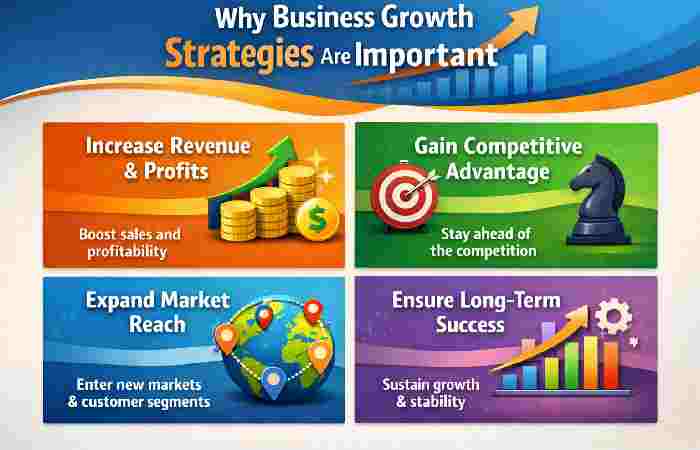
In the absence of a proper growth strategy, businesses tend to:
- Have issues with unreliable revenue.
- Spend resources on poor marketing.
- Lose competitive edge
- Inability to scale operations effectively.
An established plan assists you in:
- Set measurable goals
- Allocate resources wisely
Figure 1: Find opportunities early.
- Gain strength against market dynamics.
Types of Business Growth Strategies
Let’s begin with a foundational overview of different growth strategies.
Growth Strategy Comparison Table
| Strategy Type | Description | Risk Level | Best For |
| Market Penetration | Selling more existing products in current market | Low | Small & local businesses |
| Market Development | Entering new markets | Medium | Expanding companies |
| Product Development | Creating new products for existing customers | Medium | Innovative businesses |
| Diversification | New products in new markets | High | Large or mature companies |
Market Penetration Strategy

This is one of the safest and most common growth strategies. It focuses on increasing your market share within your existing customer base.
How to Execute It:
- Offer discounts or loyalty programs
- Improve customer experience
- Increase marketing efforts
- Encourage repeat purchases
Example Approach
If you run a clothing brand, you might:
- Launch seasonal sales
- Introduce referral discounts
- Use email marketing to re-engage customers
Key Advantage:
Low risk and quick results.
Market Development Strategy
This strategy involves entering new markets with your existing products.
Possible Approaches:
- Expanding to new geographic regions
- Targeting a new demographic group
- Exploring online marketplaces
Example:
A local bakery expanding from one city to multiple cities or offering delivery nationwide.
Challenges:
- Understanding new customer behavior
- Adapting marketing strategies
- Managing logistics
Product Development Strategy
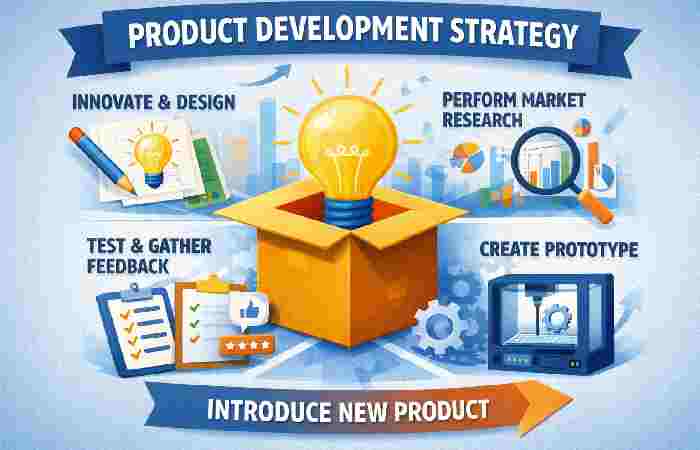
Here, the focus is on creating new products or improving existing ones to attract your current customers.
Why It Works:
Your existing customers already trust your brand, making it easier to introduce new offerings.
Examples:
- Adding new features to a software product
- Launching a new flavor in a food business
- Upgrading existing product quality
Product Development Table
| Approach | Description | Impact Level |
| Innovation | Creating entirely new products | High |
| Improvement | Enhancing existing products | Medium |
| Customization | Tailoring for specific audiences | Medium |
Diversification Strategy
This is the most ambitious and risky strategy. It involves entering completely new markets with new products.
Types of Diversification:
- Related Diversification: New products related to your current business
- Unrelated Diversification: Completely different industry
Example:
A tech company entering the healthcare sector.
Risks:
- High investment
- Lack of expertise
- Uncertain market demand
Customer-Centric Growth Strategy
Customers are at the heart of every successful business. Focusing on customer needs can drive organic growth.
Key Elements:
- Personalized experiences
- Strong customer support
- Feedback-driven improvements
Benefits:
- Increased customer loyalty
- Higher lifetime value
- Positive word-of-mouth
Digital Marketing and Online Presence
In today’s digital world, your online presence plays a huge role in business growth.
Key Channels:
- Search Engine Optimization (SEO)
- Social media marketing
- Content marketing
- Email campaigns
Digital Marketing ROI Table
| Channel | Cost Level | ROI Potential | Best Use Case |
| SEO | Low | High | Long-term traffic |
| Social Media | Medium | High | Brand awareness |
| Email Marketing | Low | Very High | Customer retention |
| Paid Ads | High | Medium-High | Quick results |
Strategic Partnerships and Collaborations
Collaborating with other businesses can accelerate growth.
Types of Partnerships:
- Co-branding
- Affiliate marketing
- Joint ventures
Example:
A fitness brand partnering with a nutrition company.
Advantages:
- Shared audience
- Reduced marketing costs
- Increased credibility
Innovation and Technology Adoption
Businesses that embrace innovation stay ahead of the curve.
Areas to Innovate:
- Automation tools
- Artificial intelligence
- Data analytics
- Customer experience platforms
Impact of Technology
| Area | Traditional Approach | Modern Approach | Benefit |
| Customer Support | Manual | Chatbots & AI | Faster response |
| Marketing | Generic ads | Targeted campaigns | Higher conversions |
| Operations | Manual processes | Automation | Cost efficiency |
Scaling Operations Efficiently
Growth is not just about sales—it’s also about handling increased demand.
Key Considerations:
- Hiring the right talent
- Streamlining processes
- Investing in infrastructure
Common Mistake:
Growing too fast without proper systems in place.
Financial Planning and Investment
No growth strategy works without proper financial management.
Important Aspects:
- Budget allocation
- Cash flow management
- Investment planning
Financial Planning Table
| Aspect | Importance Level | Key Action |
| Cash Flow | Critical | Monitor regularly |
| Budgeting | High | Allocate wisely |
| Investment | Medium-High | Focus on ROI |
Branding and Positioning
A strong brand builds trust and recognition.
Key Elements:
- Clear brand message
- Consistent visual identity
- Unique value proposition
Why It Matters:
Customers choose brands they trust and relate to.
Data-Driven Decision Making
Successful businesses rely on data rather than guesswork.
Metrics to Track:
- Customer acquisition cost (CAC)
- Conversion rates
- Customer lifetime value (CLV)
- Revenue growth rate
Benefits:
- Better decision-making
- Reduced risk
- Improved efficiency
Expanding Sales Channels
Relying on a single sales channel can limit growth.
Options:
- E-commerce platforms
- Retail stores
- Direct sales
- Third-party marketplaces
Multi-Channel Strategy Table
| Channel Type | Reach Level | Cost | Scalability |
| Online Store | High | Medium | High |
| Physical Store | Medium | High | Medium |
| Marketplaces | Very High | Low | High |
Building a Strong Team
Behind every successful business is a strong team.
Key Factors:
- Hiring skilled employees
- Creating a positive culture
- Providing training and growth opportunities
Result:
Higher productivity and innovation.
Continuous Learning and Adaptation
Markets change, trends evolve, and customer preferences shift. Businesses that adapt survive and thrive.
How to Stay Updated:
- Follow industry trends
- Learn from competitors
- Invest in skill development
Common Mistakes to Avoid
Even the best strategies can fail if executed poorly. Here are some mistakes to watch out for:
- Ignoring customer feedback
- Expanding too quickly
- Lack of clear goals
- Poor financial management
- Over-reliance on one strategy
Creating Your Own Business Growth Plan
Here’s a simple framework to build your strategy:
Step-by-Step Plan
- Analyze Your Current Position
Understand your strengths, weaknesses, opportunities, and threats. - Define Clear Goals
Set measurable and realistic objectives. - Choose the Right Strategy
Align with your business model and market. - Allocate Resources
Invest time, money, and manpower wisely. - Implement and Monitor
Track progress and make adjustments.
Final Thoughts
Growth in the business is not an overnight event. It takes time and patience and readiness to change. The most winning business ventures are the ones that are able to put several prepositions together- to be innovative and stable, to be ambitious and careful.
It is not merely growth as far as becoming larger, but becoming better.
Pay attention to value creation, customer insight, and good systems. Then growth will come as a natural process instead of an incessant battle.