
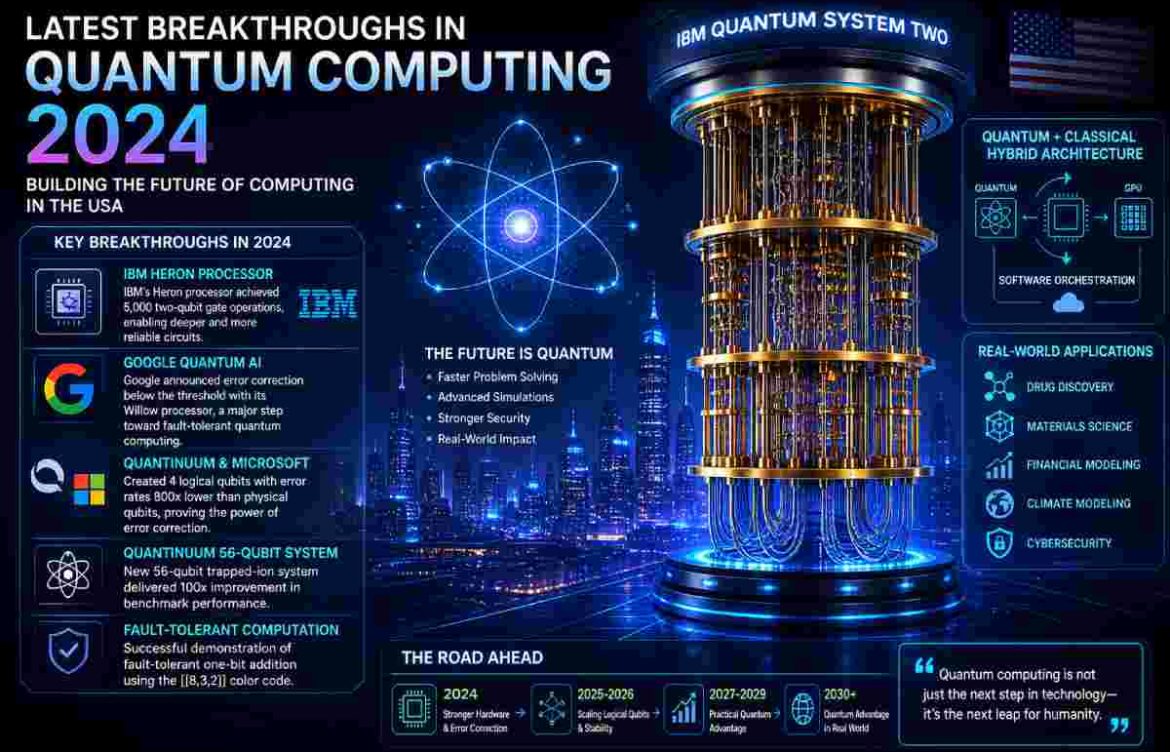
Latest Breakthroughs in Quantum Computing 2024 – (USA) – IBM, Google & Beyond
2024’s biggest quantum news-which, to some extent, is a general change-is that the industry has officially moved past it feeling like a promise, and toward something more like an engineering competition. But in the U.S., it wasn’t merely “more qubits.” Rather, we got improved qubit designs, improved error correction schemes and, critically, improved system designs. IBM continued to explore useful circuit execution in greater depth, while Google Quantum AI stated it has demonstrated sub-threshold error correction in its newest superconducting chips and Quantinuum and Microsoft demonstrated a logical qubit can be demonstrably superior to its physical counterparts. Overall, they hint toward a real exploration of practical architecture decisions, instead of just dazzling demonstrations.
What quantum computing means, in simple terms
A quantum computer processes information using principles of quantum mechanics which classical computers are not adept at. The basic unit of quantum computation is a qubit; this acts very differently to the bits on a conventional computer as it can utilize both superposition and entanglement. This does not mean quantum computers instantly outperform classical machines at all tasks. It means they may become especially valuable for certain problems in chemistry, materials, simulation, optimisation, and some hard sampling tasks.
| Term | Plain-English meaning |
| Qubit | A quantum version of a bit that can represent more than one state at once in certain contexts. |
| Physical qubit | A real hardware qubit on a processor. |
| Logical qubit | A protected qubit built from several physical qubits using error correction. |
| Quantum error correction | A method for detecting and correcting errors without destroying the quantum information. |
| Quantum utility | The point where a quantum computer can do useful work beyond brute-force classical simulation for some tasks. |
2024 breakthroughs at a glance
| Breakthrough | Platform / company | What changed in 2024 | Why it matters |
| IBM Heron + Quantum System Two | IBM, U.S. quantum data centers | IBM stated that Heron can perform some circuits up to 5,000 two-qubit gates, and that the same benchmark test can run in much less time compared to the 2023 utility benchmark. | This suggests that there is moving on from the pure qubit count to practical circuit depth and software/hardware co-design. |
| Below-threshold surface-code memory | Google Quantum AI | Google reported a distance-7 and distance-5 surface-code memory on Willow processors, with the larger memory showing logical error suppression and even outperforming its best physical qubit lifetime. | This is one of the clearest signs yet that error correction can work in the right regime instead of only in tiny laboratory demos. |
| Reliable logical qubits | Quantinuum + Microsoft | The teams reported four logical qubits with error rates 800 times lower than the corresponding physical error rates. | Logical qubits are the real bridge to fault-tolerant quantum computing, so this matters more than a simple qubit-count headline. |
| 56-qubit trapped-ion machine | Quantinuum | Quantinuum launched a 56-qubit trapped-ion system and reported a 100x improvement over a prior random-circuit benchmark. | This shows trapped-ion systems remain highly competitive on fidelity and benchmark performance, not just qubit number. |
| Fault-tolerant one-bit addition | Quantinuum H1-1 | Researchers ran a small algorithm fault-tolerantly using the [[8,3,2]] color code and reduced arithmetic error from about 9.5×10^-3 to about 1.1×10^-3. | This is important because it proves fault tolerance is not only theoretical; even small algorithms can benefit from encoding. |
IBM’s big 2024 move: from hardware novelty to useful workload depth
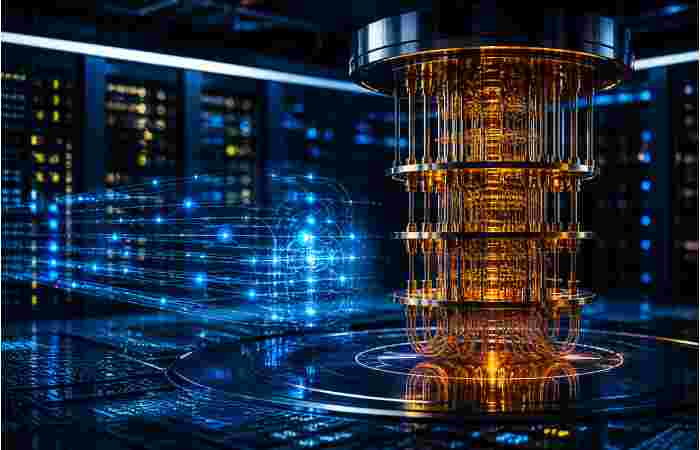
IBM’s November 2024 announcement was less about a flashy one-day demo and more about building a platform that can support deeper, more useful workloads. The company said its Heron processor could accurately run certain circuit classes with up to 5,000 two-qubit gate operations, and that the same benchmark-style workload could be completed in 2.2 hours instead of 112 hours in its earlier 2023 utility experiment. That is not “solve everything” territory, but it is a strong sign that the field is improving in the dimensions that actually matter: circuit depth, stability, and software stack quality.
More intriguingly, is the implicit message of the headline. IBM is definitively moving to a quantum-centric model, where the quantum processor, the CPUs, the GPUs and software orchestration operate in concert, rather than the quantum chip being a stand alone miracle box, as a first pass for real world quantum use will almost certainly appear as hybrid, not classical replacement.
Google’s 2024 result: a real step toward error correction that scales
Google Quantum AI’s Nature paper, published in December 2024, is one of the most important scientific milestones of the year. The team reported below-threshold surface-code memories on its newest superconducting processors, including a distance-7 code built on 101 qubits. The larger logical memory showed error suppression when the code distance increased, and it even outlasted its best physical qubit by a meaningful margin. The paper also reported real-time decoding at microsecond latency, which matters because error correction is only useful if the classical decoder can keep up with the quantum device.
What makes this result stand out is that it shifts the conversation from “we can detect errors” to “we can suppress them below the threshold where scaling starts to make sense.” That distinction is huge. Many experiments can spot noise; far fewer can show that extra protection actually improves logical performance as the system gets larger. Google’s 2024 result is therefore less like a one-off benchmark and more like a proof that the architecture is crossing into the regime that fault-tolerant computing needs.
Quantinuum and Microsoft: logical qubits became harder to dismiss
On April 3, 2024, Quantinuum and Microsoft announced that they had created four logical qubits with error rates 800 times lower than the physical error rates they came from. They also reported 14,000 error-free circuit instances in the same collaboration. For anyone following quantum computing closely, the significance is obvious: this is not just about making a device “bigger,” but about making information more reliable once it is encoded.
Quantinuum’s own description shows why the result mattered so much. The team created the four logical qubits using 30 out of 32 physical qubits available on their H2 processor, and successfully showed that syndrome extraction is part of a fault tolerant computation-i.e. The machine was doing the kinds of book keeping a fault-tolerant computer will need, rather than just doing cool quantum tricks.
Why Quantinuum’s 56-qubit machine still mattered
A few months later, Quantinuum followed up with a 56-qubit trapped-ion machine, H2-1. The company said it achieved a 100x improvement over prior industry results on a random-circuit-sampling benchmark and that the system was difficult for classical computers to fully simulate. It also highlighted the machine’s high fidelity and all-to-all connectivity, which are major strengths of trapped-ion architectures.
This matters because quantum progress is not measured by one number alone. Superconducting systems, trapped-ion systems, and other platforms each trade off speed, fidelity, connectivity, and scale. Quantinuum’s 2024 story showed that a smaller number of very reliable qubits can still produce headline-making results, especially when benchmark quality and logical control improve faster than raw qubit count.
Fault-tolerant one-bit addition: small, but deeply meaningful
Another 2024 milestone came from a trapped-ion experiment implementing one-bit addition fault-tolerantly on a quantum computer using the smallest interesting color code. The result cut the observed arithmetic error rate from roughly 9.5×10^-3 in the unencoded circuit to about 1.1×10^-3 in the fault-tolerant version. That kind of improvement is small in absolute terms, but huge in context, because it proves encoded computation can outperform the raw hardware path for a real algorithmic task.
This is exactly the kind of experiment the field needs more of. It does not claim full-scale quantum advantage. It does something more valuable for the near term: it shows that the theory of fault tolerance can survive contact with the lab. For industry readers, that is the difference between “interesting physics” and “future engineering roadmap.”
What these breakthroughs mean for the United States
From a U.S. perspective, 2024 was the year quantum computing became less about national ambition in the abstract and more about ecosystem execution. IBM pushed the software-hardware stack, Google showed a serious error-correction milestone, and Quantinuum with Microsoft demonstrated that logical qubits can be more than a marketing term. Together, these advances suggest the U.S. advantage is not just in having major players; it is in having multiple competing approaches that are each making measurable progress.
The practical takeaway is simple: the field is moving away from “how many qubits?” and toward “how well can the machine keep information alive, correct itself, and run useful circuits?” That is the real milestone line. When the conversation changes from qubit quantity to logical quality, the technology is maturing.
The road ahead
The biggest challenge now is scaling without losing the gains that 2024 finally made visible. IBM still points toward a future of quantum-centric supercomputing. Google’s result shows that error correction can beat the threshold in a meaningful way, but scaling such systems will require better decoding, better calibration, and better hardware stability. Quantinuum’s results show that logical qubits can be produced with impressive fidelity, but the number of logical qubits still needs to grow dramatically before the technology becomes broadly useful.
So the honest reading of 2024 is this: quantum computing is not “done,” and it is not ready to replace classical computing. But in the U.S., the field crossed several thresholds that matter far more than hype. Deeper circuits, better logical qubits, real-time decoding, and lower error rates are the building blocks of a genuine quantum computing industry. 2024 was the year those building blocks became harder to ignore.
Conclusion
If 2023 was when quantum computing could talk the talk of utility, 2024 was the year the talking was starting to turn to walk the walk, a step at a time. The breakthroughs were less ‘one-off miracles’ and more indicators that the technology is learning to engineer itself reliably. That’s generally how new technologies come into their own – sporadically and quietly, before happening all at once. For quantum computing, 2024 felt like the year when it was about to begin.