
About Hlzuine28.6 Software
HLZUINE28.6 software appears to be an unclear and lightly documented software label rather than a widely verified mainstream product. My own research on the public web is thin and uneven; even one recent article on it handles it in a reserved rather than matter-of-fact way-a not yet officially acknowledged and supported commercial application.
For Egypt, that means the most practical course for people contemplating HLZUINE28.6 would not be to assume its functionality, but instead to first ask a smarter question: Is it real, secure, supported, and applicable to what I need to do?
What HLZUINE28.6 Software May Represent?
If the software name doesn’t ring a bell and has a questionable provenance, it’s typically in one of the more common types of unusual names: an internal build, a beta, a renamed tool, a test identifier, or a name floating around on the internet. That is the safest interpretation based on the limited and cautious online material available.
In simple terms, HLZUINE28.6 should be treated like a software identity that needs verification before trust is given. That is especially important in business environments, where one unknown installer can affect data, security, and workflow stability.
Why People Search for It
Most users do not search for obscure software names by accident. Usually, they have seen one of the following:
- a file name during installation,
- a system log entry,
- a package label in a download folder,
- a reference in a forum or social post,
- or a mention from someone recommending a tool without details.
That confusion is exactly why careful evaluation matters. When a software label is not backed by clear vendor documentation, the best response is curiosity paired with caution.
A Practical View for Egypt
In Egypt, businesses and users often depend on software for communication, design, sales, finance, education, and administration. That means even a small unknown application can create larger issues if it is installed without review.
A practical approach is to ask:
- Does it have an official website or publisher?
- Is there a clear support channel?
- Does it explain what it collects or changes?
- Does it match your language, region, and system requirements?
- Is it used by real teams, or is it just circulating as a name online?
If the answer to most of these is unclear, then the software should be handled as unverified until proven otherwise.
Comparison Table: HLZUINE28.6 vs a Trusted Software Product
| Feature | HLZUINE28.6 Software | Trusted Software Product |
| Documentation | Limited or unclear | Clear user guide, help center, and changelog |
| Publisher identity | Not easy to confirm | Visible company or developer profile |
| Support | Hard to verify | Email, help desk, or community support |
| Security transparency | May be uncertain | Security policy, permissions, and updates explained |
| Updates | Unknown | Regular, documented releases |
| Risk level | Higher until verified | Lower when sourced from official channels |
| User confidence | Weak at first glance | Strong because details are traceable |
This comparison is not a claim that HLZUINE28.6 is unsafe. It is a decision framework. When software cannot be clearly identified, it should never receive the same level of trust as a known, supported product.
Core Features You Should Look For
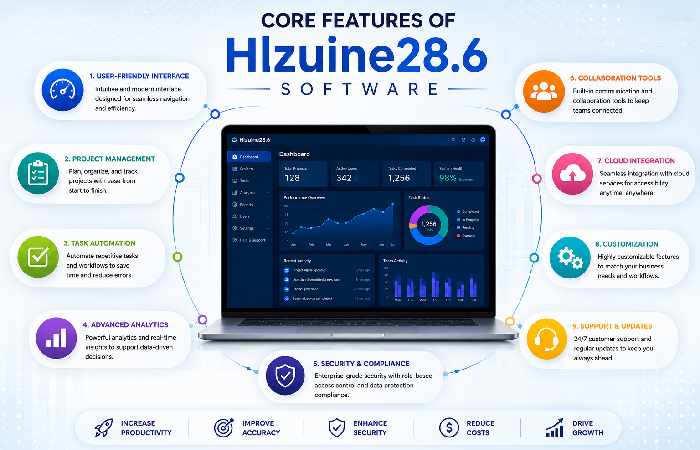
If someone is evaluating HLZUINE28.6 software, the real question is not whether the name sounds technical. The real question is whether it behaves like responsible software.
A reliable application should usually show:
- a clear installation source,
- simple version information,
- a changelog or release notes,
- predictable performance,
- control over permissions,
- and a way to remove it cleanly.
Without those basics, even a useful tool can become frustrating.
What Makes Software Worth Using?
Software earns trust when it reduces work instead of adding confusion. A good product should feel calm, understandable, and stable. It should help the user move faster without forcing them to guess what it is doing in the background.
In many Egyptians’ mind, that is even more important, as software is widely used in mixed environments: Arabic/English user interface, mixed kinds of devices, older computer hardware, business application where everything has to function all day long. The ability to “explain itself” can rarely work here.
Table: Simple Evaluation Checklist
| Checkpoint | What to Ask | Good Sign | Warning Sign |
| Source | Where did this come from? | Official website or vendor portal | Random file-sharing link |
| Purpose | What is it for? | Clear function and use case | Vague description |
| Permissions | What does it access? | Minimal and explained | Broad or hidden access |
| Updates | How is it maintained? | Regular updates and notes | No visible maintenance |
| Support | Who helps if it breaks? | Help page or support team | No contact details |
| Reviews | What do users say? | Consistent user feedback | Mostly unclear or copied content |
This table is useful whether you are a student, freelancer, office worker, or IT manager. A software name should never be enough on its own.
Benefits if It Turns Out to Be Legitimate
If HLZUINE28.6 software is later confirmed as a real, useful product, it may offer benefits similar to other modern tools. Those could include workflow automation, data handling, simple task management, device monitoring, or project support.
Potential strengths might be:
- faster routine work,
- better organization,
- fewer manual errors,
- easier collaboration,
- and centralized control.
Still, these benefits only matter after the software is verified. A tool can be powerful and still not be appropriate if its source is unclear.
Limitations and Concerns
This is where caution becomes essential.
1) Unclear documentation
If the software does not explain its purpose well, users may misconfigure it or trust it too quickly.
2) Security uncertainty
Without a known publisher, it is harder to judge whether the software respects privacy, protects data, and updates safely.
3) Compatibility issues
Unknown software may not behave well across different devices, operating systems, or language settings.
4) Weak support
When problems appear, users need answers fast. If no support exists, small issues can become expensive ones.
5) Reputation risk
In business settings, using an unknown tool can make teams hesitant. Even useful software loses value when people cannot trust it.
When to Be Careful Before Installation
Before installing any unfamiliar software, especially one with a name like HLZUINE28.6, it is wise to pause if you notice any of the following:
- the download source looks unofficial,
- the version number appears without explanation,
- the installer requests unusual permissions,
- the product page is copied, thin, or inconsistent,
- or the software has almost no verifiable history.
The goal is not fear. The goal is discipline.
Best Practices for Users in Egypt
If you are considering a tool like this in Egypt, these habits help a lot:
- keep one test device or virtual machine for unknown software,
- back up important files first,
- read every permission prompt carefully,
- avoid installing through random links,
- and compare the software against alternatives you already trust.
Even a simple routine like this can save hours later.
Table: HLZUINE28.6 vs Everyday Alternatives
| Factor | HLZUINE28.6 Software | Everyday Trusted Alternative |
| Ease of understanding | May be unclear at first | Usually easy to understand |
| Learning curve | Possibly steep if undocumented | Often smoother and guided |
| Trust level | Needs verification | Already established |
| Business readiness | Unknown | More predictable |
| Risk management | Requires extra caution | Easier to manage |
| Long-term use | Hard to judge | Easier to plan around |
This comparison shows why documentation matters so much. Good software does not just work. It also explains itself.
Who Might Actually Need It?
A tool like HLZUINE28.6 would only make sense if it solves a specific problem that other software does not. In that case, it may attract:
- curious tech users,
- IT testers,
- software researchers,
- small teams exploring new tools,
- or users who discovered it through internal sharing.
For ordinary users, though, the safer route is usually to choose software with a visible track record.
A Calm Conclusion
HLZUINE28.6 software, based on the public material currently available, should be treated as a software name that needs careful verification rather than a fully established product with a clear public identity. The online references I found are limited and cautious, which is exactly why a practical, security-first reading makes the most sense.
For Egypt-based users, the best takeaway is simple: do not rush to install or recommend software just because the name sounds technical. Check the publisher, confirm the purpose, inspect the permissions, and compare it with known alternatives. When software is clear, trust becomes easier. When software is vague, caution becomes the better investment