
Definition and Objectives of Virtual Labs
Virtual Labs is a cool project started by the Government of India to help students like you learn science and engineering through online experiments. You can think of the great lab experiments you can accomplish using your computer, even though your school may not have a fancy lab. Virtual Labs have the advantage of using the internet to bring the experiments to you and as such you can study and learn at any point in time and place.
Why Are Virtual Labs Awesome?
No Lab? No Problem! Whereas, your school may not have lab or other equipment, Virtual Labs allow you to experiment online.
Learn Your Own Time: You can use your computer to learn by experimenting and learning in an interactive and fun manner.
Get Curious: Virtual Labs allow you to feel the desire to ask and learn more about science and engineering.
Collaborate: Students and teachers anywhere in India can share the same experiments and it is easier to exchange ideas and learn.
Virtual Labs Virtual labs are online learning laboratories which simulate physical laboratory experiments in an interactive context. Users are able to perform experiments, interpretation of results and repeat procedures without any physical equipment.
They are widely used in:
- STEM Education
- Medical Training
- Engineering Simulations
- Corporate Skill Development
- Scientific Research
Key Features
| Feature | Description | Benefit |
| Simulation-Based Learning | Realistic experiment models | Risk-free experimentation |
| Cloud Access | Accessible via internet | Anytime, anywhere learning |
| Interactive Tools | Drag-and-drop instruments | Enhanced engagement |
| Data Analysis Tools | Built-in analytics | Faster result interpretation |
| Repeatable Experiments | Unlimited trials | Improved concept clarity |
Benefits of Virtual Labs
Virtual Labs offer a modern and flexible way to conduct experiments and practical learning through digital platforms. They are widely used in schools, colleges, and training programs to enhance understanding and accessibility.
1. Easy Access Anytime, Anywhere
Students can perform experiments from home, classrooms, or remote locations. Initiatives such as Virtual Labs by the Ministry of Education provide nationwide access to practical learning.
2. Cost-Effective Learning
Virtual labs reduce the need for:
- Expensive equipment
- Lab maintenance
- Chemicals and materials
- Infrastructure costs
This makes quality education more affordable for institutions and students.
3. Safe and Risk-Free Environment
Students can learn without worrying about:
- Chemical accidents
- Equipment damage
- Electrical hazards
- Health risks
This is especially useful in fields like chemistry, medicine, and engineering.
4. Repeat Experiments Multiple Times
Learners can redo experiments to improve understanding. Unlike physical labs, there are no material limitations.
5. Better Concept Clarity
Interactive simulations, animations, and real-time feedback improve comprehension. Platforms such as Coursera and edX use visual learning to enhance practical skills.
6. Flexible and Self-Paced Learning
Students can:
- Learn at their own speed
- Practice anytime
- Review lessons repeatedly
This supports personalized education.
7. Inclusive and Equal Opportunities
Virtual labs help students in rural or underserved areas access the same quality education as urban learners.
8. Environmentally Friendly
They reduce:
- Chemical waste
- Energy usage
- Material consumption
This promotes sustainable learning.
9. Improves Digital Skills
Students develop:
- Technical literacy
- Data analysis skills
- Problem-solving abilities
These are important in today’s digital world.
10. Supports Modern Education Trends
Virtual labs align with:
- Online education
- Remote learning
- AI and AR/VR integration
- Smart classrooms
Types
| Type | Purpose | Target Users |
| STEM Virtual Labs | Physics, Chemistry, Biology simulations | School & College Students |
| Medical Virtual Labs | Anatomy, surgery simulations | Medical Students |
| Engineering Labs | Circuit design, mechanical simulations | Engineering Students |
| Research Simulations | Advanced scientific modeling | Researchers |
| Corporate Training Labs | Skill-based training modules | Employees |
How Do Virtual Labs Work?
Virtual Labs let you use online tools and simulations to do experiments. For example, you can mix chemicals, build circuits, or test machines—all on your computer! These labs are designed to help you understand tough concepts by letting you “see” and “do” things yourself.
The Journey
- Phase 1: Over 100 Virtual Labs were created with more than 700 experiments. These are like online playgrounds where you can try out different science activities.
- Phase 2: The focus was to make these labs easier to use by putting them on one platform. They also made some labs free and open for everyone to use.
- Phase 3: Now, they’re working on creating new experiments, testing them to make sure they’re great, and storing them on a central server so anyone can access them.
Limitations
| Limitation | Impact |
| Lack of Physical Hands-On Experience | Reduced tactile learning |
| Internet Dependency | Requires stable connectivity |
| Limited Real-World Variables | Simulations may oversimplify |
| Initial Development Cost | High software creation expense |
Who Can Use Virtual Labs?
- Students like you: Whether you’re in a big city or a small town, Virtual Labs help you do experiments and learn cool stuff.
- Teachers: They can use Virtual Labs to teach better and make classes more exciting.
- High School Students: Virtual Labs can make you curious about science and maybe even inspire you to become a scientist or engineer!
- Colleges and Researchers: They can share tools and ideas to do bigger experiments.
How Are Virtual Labs Made Better?
The people behind Virtual Labs follow special steps to make sure everything works well:
- Quality Check: They make sure every experiment is fun and teaches you something useful.
- Feedback: They ask students and teachers what they think to improve the labs.
- Expert Advice: Scientists and teachers check the labs to make sure they’re accurate.
- Teamwork: Everyone shares ideas on a special platform, like a big online notebook.
Why Should You Try Virtual Labs?
Virtual Labs are like a science adventure! They let you experiment, make mistakes, and learn without needing a real lab. They’re perfect for curious minds like yours who want to explore how things work. Plus, they make learning fun and help you understand big ideas in science and engineering.
Technologies Behind Virtual Labs
Virtual Labs rely on modern digital technologies such as:
- Cloud Computing
- Artificial Intelligence (AI)
- Virtual Reality (VR)
- Augmented Reality (AR)
- Machine Learning
- 3D Simulation Engines
Best Virtual Labs
Here are some of the best Virtual Labs with key details in a table format:
India
| Virtual Lab / Platform | Developed By | Focus Areas | Key Features | Ideal For |
| Virtual Labs | Ministry of Education (MHRD), Govt. of India | Engineering, Science, Biotechnology | Free remote lab access, simulations, experiments | School, college, and university students |
| IIT Bombay Virtual Labs | Indian Institute of Technology Bombay | Electronics, Computer Science, Mechanical | Real-time simulations, remote access | Engineering and technical students |
| Amrita Virtual Labs | Amrita Vishwa Vidyapeetham | Biotechnology, Biomedical, Physics | Interactive modules and research-based labs | Science and biotech learners |
| IIT Delhi Virtual Labs | Indian Institute of Technology Delhi | Electrical, Computer Science | High-quality digital learning and remote experimentation | Undergraduate and postgraduate students |
| IIT Kharagpur Virtual Labs | Indian Institute of Technology Kharagpur | Civil, Mechanical, Electrical | Industry-oriented simulations | Engineering and diploma students |
| IIIT Hyderabad Virtual Labs | International Institute of Information Technology Hyderabad | VLSI, AI, Embedded Systems | Advanced digital and microelectronics labs | Tech and AI learners |
| Dayalbagh Educational Institute Virtual Labs | Dayalbagh Educational Institute | Physical and Chemical Sciences | Practical learning and simulations | Science and chemistry students |
| NITK Surathkal Virtual Labs | National Institute of Technology Karnataka | Electronics, VLSI | Circuit design and testing | Engineering and research students |
USA
| Virtual Lab Platform | Focus Area | Key Features | Used By | Website Origin |
| Labster | Biology, Chemistry, Physics | 3D simulations, gamified learning, VR support | Universities & schools | USA |
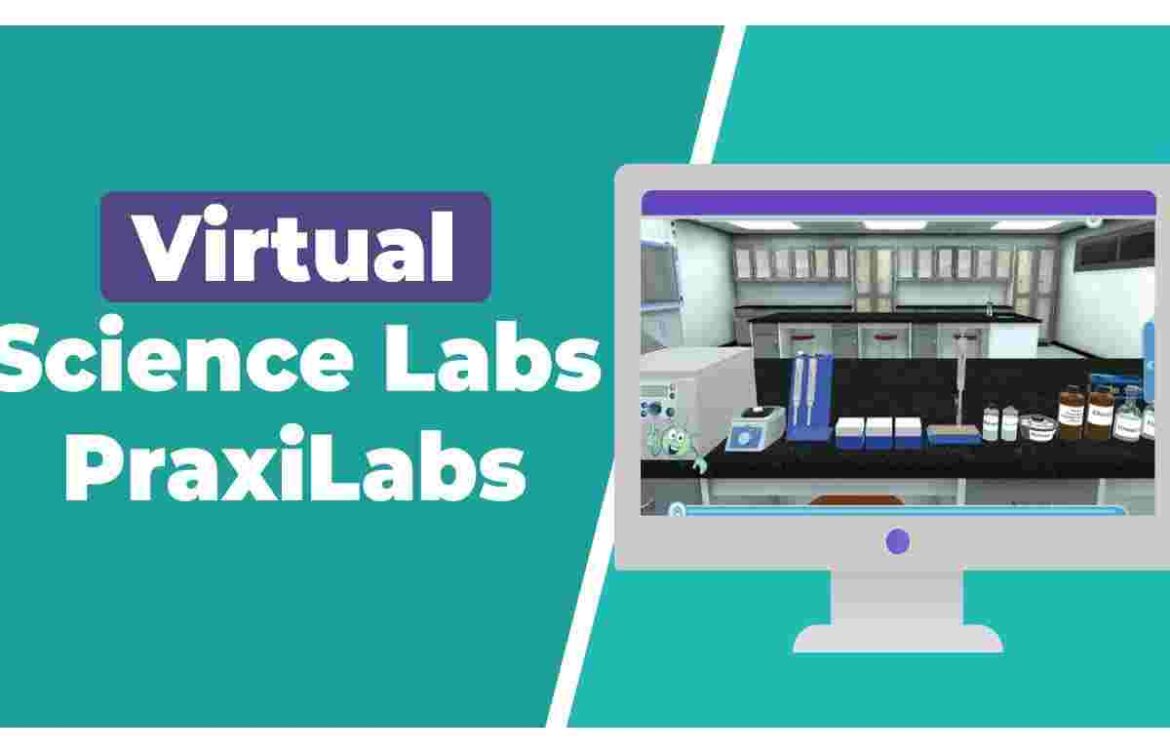
| PraxiLabs | STEM education | 3D experiments, LMS integration, analytics | Colleges & schools | Global (widely used in USA) |
| PhET Interactive Simulations | Physics, Chemistry, Math | Free simulations, interactive models | K–12 & universities | USA |
| HHMI BioInteractive | Biology & life sciences | Virtual experiments, animations | High schools & colleges | USA |
| iLab Solutions | Engineering & science | Remote access to real lab equipment | Universities & research | USA |
| Practice Labs | IT & cybersecurity | Cloud-based labs, real software tools | Professionals & students | USA |
| WhimsyLabs | K–12 STEM | AI-powered experiment builder | Schools | USA |
| VRLab Academy | Science & VR | Immersive virtual experiments | Schools & institutes | Global |
London
| Virtual Lab / Platform | Focus Area | Key Features | Used By | Location |
| Imperial College London – CREATE Remote Lab | Chemical engineering & science | Remote control of real lab equipment, AR & live experiments | Students & researchers | London |
| Imperial College London – ViRSE Platform | VR simulations & research | Interactive 3D simulations, crowd dynamics, geology & engineering | University learners | London |
| University College London – Immersive Virtual Environments Lab | VR, AR, mixed reality | Advanced visualization, interaction, user experience research | Higher education | London |
| VRLab Academy | Science education | 240+ simulations aligned with GCSE, IB, AP curricula | Schools & colleges | London |
| PraxiLabs | STEM | Gamified 3D experiments, LMS integration, analytics | Universities & schools | Used in UK & London |
| iXR Labs | Engineering, medical, nursing | AI & VR modules, immersive learning | Universities | Global & UK |
| Virtual Scientia | Life sciences & healthcare | Realistic 3D environments, interactive experiments | Medical & science students | UK |
Global Growth
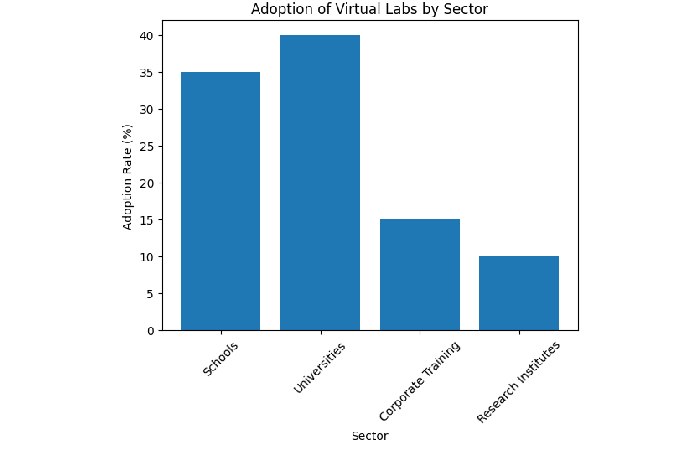
The rise of e-learning platforms and remote education, especially after global digital transformation initiatives, has significantly increased the demand for virtual laboratory platforms.
Growth Drivers:
- Expansion of online education
- Reduced infrastructure budgets
- Remote learning trends
- Need for scalable training systems
- Industry 4.0 transformation
Educational Impact
These labs improve:
- Concept clarity
- Student engagement
- Experiment repetition
- Self-paced learning
- Analytical thinking
Studies show improved theoretical understanding when simulations are integrated with traditional teaching methods.
Corporate and Industry Use
Companies use these labs for:
- Employee technical training
- Safety simulations
- Machinery operation training
- Software skill development
This reduces training costs and improves efficiency.
Future of Virtual Labs
The future of virtual labs includes:
- Integration with VR headsets
- AI-based adaptive experiments
- Real-time collaboration tools
- Blockchain-based certification
- Metaverse-based laboratory environments
They are expected to become a core component of global digital education systems.
Conclusion
Virtual Labs are an exciting way to dive into science and engineering. They help you learn by doing experiments on your computer, spark your curiosity, and make you want to explore more. So, grab your computer, visit Virtual Labs, and start your science adventure today!