
Home Tech World — The Ultimate 2026 Guide
Home Tech World is the world-wide system of technological appliances applied in the current-day households – a combination of smart home, automation, IoT connectivity, AI applications, entertainment technology, energy management, and robotics that aim to make houses more comfortable, efficient, secure, and entertaining.
This world does not just end at mere gadgets. It now comprises of complex environments where devices interact, evolve and provide customized experience depending on facts and user patterns.
Essentially, Home Tech World is a company that converts physical living environments into intelligent systems that enhance the daily living environment with connection, automation, and data-driven revelations.
About Home Tech World
Home Tech World refers to the growing ecosystem of smart technologies, digital devices, and automated systems designed to make homes more comfortable, secure, energy-efficient, and connected. It combines innovations such as smart appliances, automation, security systems, and IoT (Internet of Things) devices that allow homeowners to control and monitor their living spaces remotely through smartphones or voice assistants.
In recent years, the concept of smart living has expanded globally, especially in countries like India, the United Kingdom, and the United States, where smart home adoption continues to grow due to technological advancements and increased awareness of energy conservation and home security.
Major Segments of Home Tech World
| Segment | Description | Examples | Growth Trend |
| Smart Home Devices | Internet-connected automation systems | Smart lights, smart thermostats, Alexa, Google Nest | Very High |
| Home Entertainment Systems | Audio & visual technology | Smart TVs, soundbars, gaming consoles | High |
| Home Security Systems | Safety & monitoring technology | CCTV cameras, video doorbells, smart locks | Very High |
| Home Appliances | Digitally enhanced appliances | Smart refrigerators, washing machines | Moderate |
| Home Office Tech | Work-from-home equipment | Laptops, WiFi routers, ergonomic chairs | Growing |
The Evolution of Home Technology
To understand today’s Home Tech World, it helps to look at its evolution:
Early Phase: Basic Appliances
Originally, homes contained standalone appliances — refrigerators, vacuum cleaners, landline phones, and TVs — with very limited connectivity.
Smart Device Emergence
As the Internet of Things (IoT) developed, devices gained networking capability, enabling remote control via apps and voice assistants.
Integrated Smart Homes
Today’s systems feature interconnected devices that share data, integrate via hub-systems, and use AI to automate behavioral routines.
Examples include:
- Smart lighting and heating systems
- Connected security systems
- Voice-controlled assistants
- Smart appliances that track usage and inventory
Key Features of Home Tech World
Home Tech World focuses on integrating smart technology into everyday living to improve comfort, security, efficiency, and convenience. Below are the main features that define a modern smart home ecosystem:
1️. Smart Home Automation
Automates lighting, fans, curtains, appliances, and climate control systems.
Remote control via smartphone apps
Scheduled operations
Scene-based settings (e.g., “Movie Mode”, “Sleep Mode”)
2️. Voice Control Integration
Voice assistants allow hands-free operation of devices.
Compatible with Amazon Alexa
Works with Google Assistant
Supports Apple Siri
3️. Smart Security Systems
Enhances home safety with advanced monitoring tools.
Smart CCTV cameras
Video doorbells
Motion sensors
Biometric and smart locks
Real-time alerts on mobile devices
4️. Energy Management & Efficiency
Helps reduce electricity usage and lower bills.
Smart thermostats
Energy-monitoring plugs
Automated lighting systems
Solar integration compatibility
5️. Connected Smart Appliances
Modern appliances connect to Wi-Fi for remote monitoring and control.Smart refrigerators
Washing machines
Air conditioners
Ovens and dishwashers
Brands like Samsung and LG lead in this category.
6️. IoT Connectivity
Devices communicate with each other using Internet of Things (IoT) technology.
Centralized app control
Real-time data syncing
Cloud-based storage
7️. Health & Comfort Monitoring
Improves indoor living conditions.
Smart air purifiers
Air quality monitors
Smart beds and sleep trackers
Climate control systems
8️. Smart Entertainment Systems
Enhances media and leisure experiences.
Smart TVs
Streaming integration
Multi-room audio systems
Voice-controlled home theatres
9️. Remote Access & Control
Control your home from anywhere in the world.
Mobile app dashboards
Real-time notifications
Live camera viewing
Core Components of the Home Tech World
Here’s a breakdown of the major sub-sectors driving this industry:
| Component | Definition | Benefits |
| Smart Appliances | Internet-connected devices like smart fridges, thermostats | Convenience, energy savings |
| Automation Platforms | Central systems controlling multiple devices | Integrated home control |
| Security & Surveillance | Smart locks, cameras, sensors | Improved safety + remote monitoring |
| Energy Management | Smart meters & thermostats | Reduced bills + sustainability |
| IoT Connectivity | Networking of devices via Wi-Fi or protocols | Interdevice communication |
| AI Assistants | Voice systems like Alexa or Google Assistant | Hands-free control |
| Home Robotics | Mobile robots doing household tasks | Physical automation |
| Entertainment Tech | Smart TVs, streaming hubs | Enhanced leisure experiences |
| Human-Machine Interfaces | Control via app, voice, gesture | Personalized interaction |
This ecosystem collectively forms the backbone of Home Tech World.
Global Market Size & Growth Trends
The smart home and home technology market is now one of the fastest-growing tech sectors worldwide:
Market Value & Growth
The global smart home market revenue was estimated at USD ~100.4 billion in 2023 and is expected to reach ~USD 174 billion by 2025, continuing to grow robustly through 2029.
Other forecasts project the home automation market to reach USD 534.8 billion by 2030, growing at ~14.4% CAGR.
Adoption Rates
An estimated 478 million households will use smart devices by 2025, growing to ~672 million by 2027.
In the U.S., more than 80% of homes contain some smart tech.
Device Proliferation
The number of connected devices per household continues to rise due to affordability and innovation, driving demand for seamless integrations and smarter UX designs.
Home Tech World — Market Share by Segment (Pie Chart 2026)
Below is a conceptual pie chart representing how different categories contribute to the global Home Tech market — based on trends in revenue and adoption estimates:
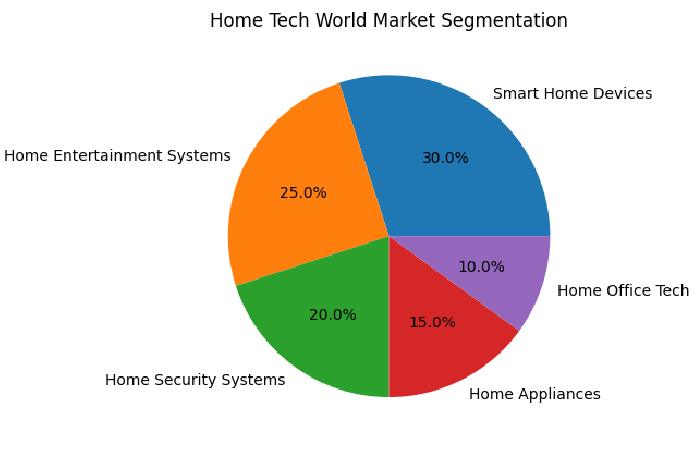
This breakdown draws from multiple market research sources showing smart appliances, security, and connectivity leading adoption. Actual percentages may vary slightly by region and data issuer.
Popular Smart Devices in Modern Homes
| Device Type | Main Benefit | Price Range (Approx.) | Popular Brands |
| Smart Speaker | Voice control & automation | ₹3,000 – ₹10,000 | Amazon Echo, Google Nest |
| Smart TV | Streaming & 4K viewing | ₹15,000 – ₹1,00,000 | Samsung, LG, Sony |
| Smart Doorbell | Video monitoring | ₹5,000 – ₹20,000 | Ring, CP Plus |
| Smart AC | Energy saving & remote control | ₹30,000 – ₹60,000 | Daikin, Voltas |
| WiFi Router | High-speed connectivity | ₹2,000 – ₹15,000 | TP-Link, Netgear |
The Trends that will influence Home Tech in 2026.
Trend 1: AI Everywhere
AI has become at the center of the home technology:
Devices get to know the user patterns in order to automate lighting, heating and entertainment.
AI-based energy systems are able to streamline usage and minimize expenditures.
Trend 2: Privacy-First Tech
Privacy concerns are closely related to data-driven homes, which also contributes to a rise in demand of devices that provide transparency and security, including local computing and edge processing.
Trend 3: Standards of Interoperability.
Devices of other brands are interoperating with each other without much fragmentation as the Matter protocol and variants are facilitating this development.
Trend 4: Smart Energy Management is anticipated to be present in the future.
One of the biggest priorities of sustainability is smart thermostats, energy monitoring, solar integration, and grid-responsive controls.
Trend 5: Home Robotics
Robots that do the dishes, laundry and other household work are becoming the Zero Labor Home technology.
Trend 6: Integration of Aesthetics and Design.
Up-market finishes, designs of devices which fit into the interiors are becoming a focus – no longer the boxes of plastic on the walls.
Regional Adoption Patterns
While adoption varies globally, some trends are consistent:
North America
Leading in adoption and revenue.
Heavy use of security and entertainment tech.
Asia Pacific
Rapid growth due to expanding middle class and infrastructure upgrades.
Europe
Strong emphasis on energy management and sustainability.
Emerging Regions
Latin America, Middle East & Africa show increasing interest as broadband access grows.
Real-World Applications of Home Tech
Intelligent Surveillance and Protection.
The peace of mind and real-time monitoring can be received by smart locks, cameras, alerts, and AI-powered threat detection.
Energy & Environment Control
Temperature, humidity, and ventilation systems that automatically change to minimize waste and make the place more comfortable.
Health & Wellness
Wellness is improved through air purifiers, ergonomic sensors, and smart lighting that mimic the natural cycles.
Entertainment & Media
The televisions, voice assistants, and streaming centers form home theaters.
Domestic Robotics
Robotics are changing the nature of chores and domestic help forcing the elimination of the vacuum robots to humanoid assistants.
Aging In Place and Accessibility.
Technology that helps older adults live independently with the help of remote monitoring and notifications.
Challenges and Risks
Privacy & Security
Smart houses are insecure unless secured appropriately – information leaks and unauthorized access are issues.
Interoperability Issues
Brands do not necessarily integrate well, and there is a disjointed experience.
Cost Barriers
Advanced systems are still very costly to many even as prices have gone down.
Tech Dependence
It is a contentious issue whether people are over-relying on automated systems and that such a practice could lead to the loss of fundamental skills.
Challenges in the Home Tech World
| Challenge | Description | Possible Solution |
| High Initial Cost | Smart devices can be expensive | EMI & bundled offers |
| Privacy Concerns | Data security risks | Use secure networks |
| Compatibility Issues | Devices may not sync | Choose ecosystem-based products |
| Technical Complexity | Setup difficulty | Professional installation |
The Future of Home Tech World
Home Tech World is expected to entail the following in the next decade:
- Increased number of independent robots performing physical jobs.
- Power generating, storing and optimization of energy-independent homes.
- The real ease-of-use ecosystems where devices will evolve dynamically without any human intervention.
- Deep-rooted biometric systems of security in personal living rooms.
These developments are not only convenient but also need to consider the ethical and privacy standards keenly.
Conclusion — Why Home Tech World Matters
Home Tech World is not only a matter of gadgets, but the redefinition of how humans live, interact and live within their surroundings. This industry is redefining the home as an interactive and customized environment through connectedness, AI and design-focused innovation.
Its further development will have an effect on sustainability and energy consumption as well as on the character of domestic labor and social relations of people with machines.