
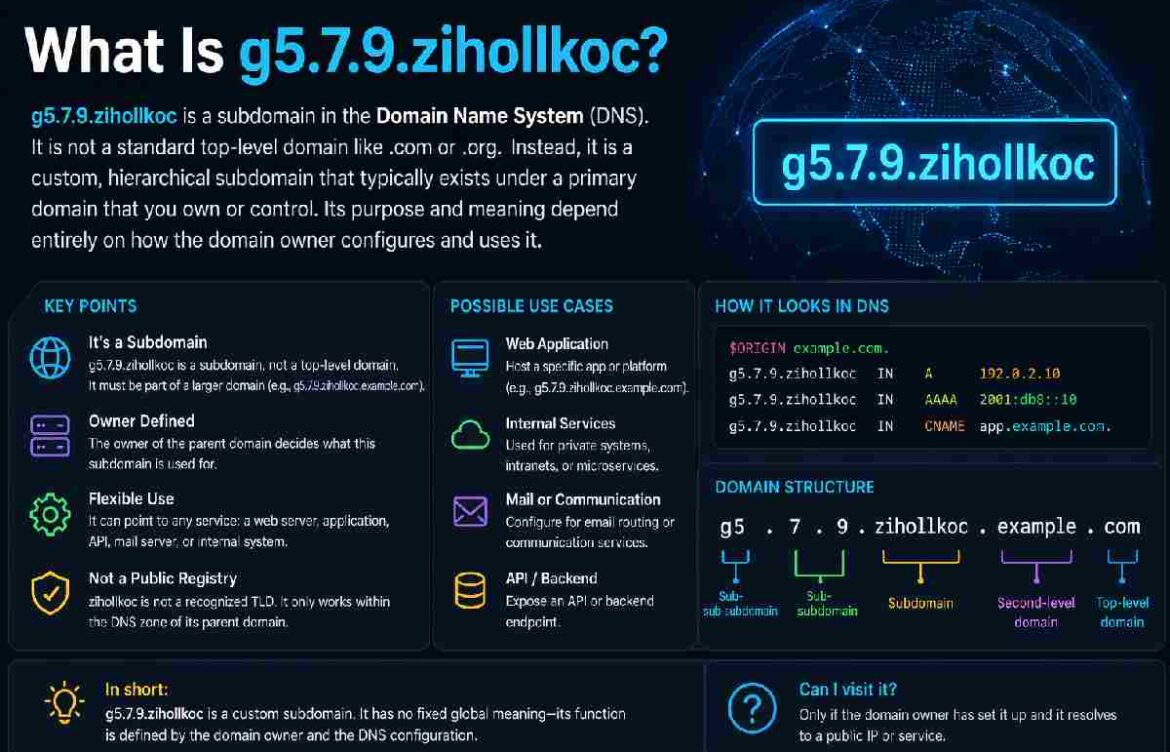
What Is g5.7.9.zihollkoc? Meaning, Uses, and Complete Guide
What is g5.7.9.zihollkoc? – On its own, g5.7.9.zihollkoc does not appear to be an ordinary word, brand, or consumer-facing product. Among the sources that I was able to find on it, there was no official public definition to it. The most similar interpretations describe it as a form of structured identification – what appears to be the type of coded string that may appear in server logs, internal builds, internal test systems, tracking software, and more.
In other words, it is less like a word in a sentence, and more like a computer label. Labels like this are commonly used to keep information ordered within systems, particularly in situations where the system has to catalog various releases, sessions, versions, or other internal markers. This is likely what makes the string seem like it does not make sense at first while still making perfect sense within a computer system.
Why do people search for g5.7.9.zihollkoc?
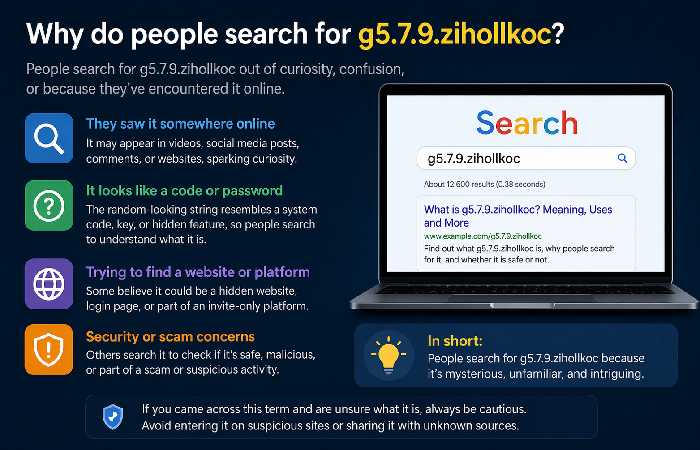
Users often search strange strings like these for one of three reasons: they saw it in an app, they found it in a page source or an error message, or they noticed it while browsing some suspect looking code. It’s understandable to be curious about something like that – code-like identifiers often appear significant even if they’re not intended to be viewed by end-users. The available writeups about this string also frame it as something people encounter while trying to understand a system label rather than a normal public term.
A simple definition
Definition:
An identifier is a label used by a system to distinguish one item, version, build, record, or event from another.
That is the most practical way to think about g5.7.9.zihollkoc. The structure shown in the sources appears to be a label constructed of a prefix, a number like a version number, and a particular suffix. Without a context that relates the label to a system or application it is of little use for a common user.
What the parts may suggest
| Part | What it may suggest | Why it matters |
| g5 | A group, branch, or build family | Prefixes often help systems sort related records |
| 7.9 | A version-like sequence | Numeric blocks are commonly used to show release stages |
| zihollkoc | A unique suffix | A custom ending often distinguishes one record from another |
This is an interpretation, not an official decoding. The important point is that the structure looks intentional, not random. That is why several explanations describe it as a structured digital label rather than a normal phrase.
Comparison table: how it differs from common labels
| Type | Example | Public meaning | Typical use |
| Regular product name | “Zoho CRM” | Easy to understand | Marketing and public-facing pages |
| Version string | “5.7.9” | Shows update order | Software releases and patch tracking |
| Build tag | “g5.7.9.alpha” | Internal release reference | Testing and deployment |
| Internal identifier | “g5.7.9.zihollkoc” | Usually system-specific | Logs, records, or internal tracking |
| Random text | “xqv-93-ll” | No clear structure | Temporary placeholders or test data |
This comparison helps show why the string feels technical. It behaves more like an internal label than a public title or article keyword.
Where might someone see it?
Something like this could be present within a system message, development dashboard, backend log, test instance, or an in-progress rendered page. Other sources suggest that such identifiers can be anything you might find within a piece of software, database, version control system, or internal tracking tool.
When seen on a public page, it is safer to not assume this is a brand, a finished product, or similar, but instead an internal label not designed for the human reader; this is often the case when the string appears without obvious surrounding context.
The Philippines angle
The “Philippines” part of your keyword is interesting because Zoho has run Philippines-related events such as Zoholics Philippines 2024 and Grow with Zoho – Philippines – 2025. Zoho also describes Zoholics as its user conference, built around product learning, networking, workshops, and one-on-one sessions.
That said, I did not find an official source connecting g5.7.9.zihollkoc itself to Zoho’s Philippines events. So the safest reading is this: the Philippines keyword may be part of the way the topic is being searched, while the code string itself still looks like an internal identifier rather than a public event name.
Is it something to worry about?
Just because a string of code-like characters is displayed, doesn’t mean something is dangerous. The critical factor is where it came from. If displayed within a trusted system, it might be benign. If displayed on an untrusted page with odd behaviors then the dangerous component is the untrusted page and not the displayed code. Articles covering this term stress the need to check the source of the string, search for error messages which go along with it and confirm with an authoritative source before jumping to conclusions..
How to read it in practical terms?
Think of g5.7.9.zihollkoc as a label with three possible jobs:
- It may mark a version.
- It may mark a build.
- It may mark a record or system entry.
That approach keeps the meaning grounded. Instead of forcing it into a normal-language definition, it treats the string as a technical reference that only makes full sense inside the system that created it.
Key takeaways
| Takeaway | Meaning |
| It is not a common public phrase | It looks technical, not conversational |
| It resembles a structured identifier | The format suggests internal use |
| Context matters most | The source determines what it means |
| Philippines may be search context | The code itself is not clearly tied to a public Philippine event |
| Official confirmation matters | Never assume a code is a brand or product without evidence |
Final thought
The best way to understand g5.7.9.zihollkoc – Philippines is to treat it as a system-style identifier first and a public topic second. That keeps the interpretation careful, useful, and realistic. In the sources available, the string is discussed as a structured label, while Zoho’s Philippines pages point to real events such as Zoholics and Grow with Zoho, not to this exact code